
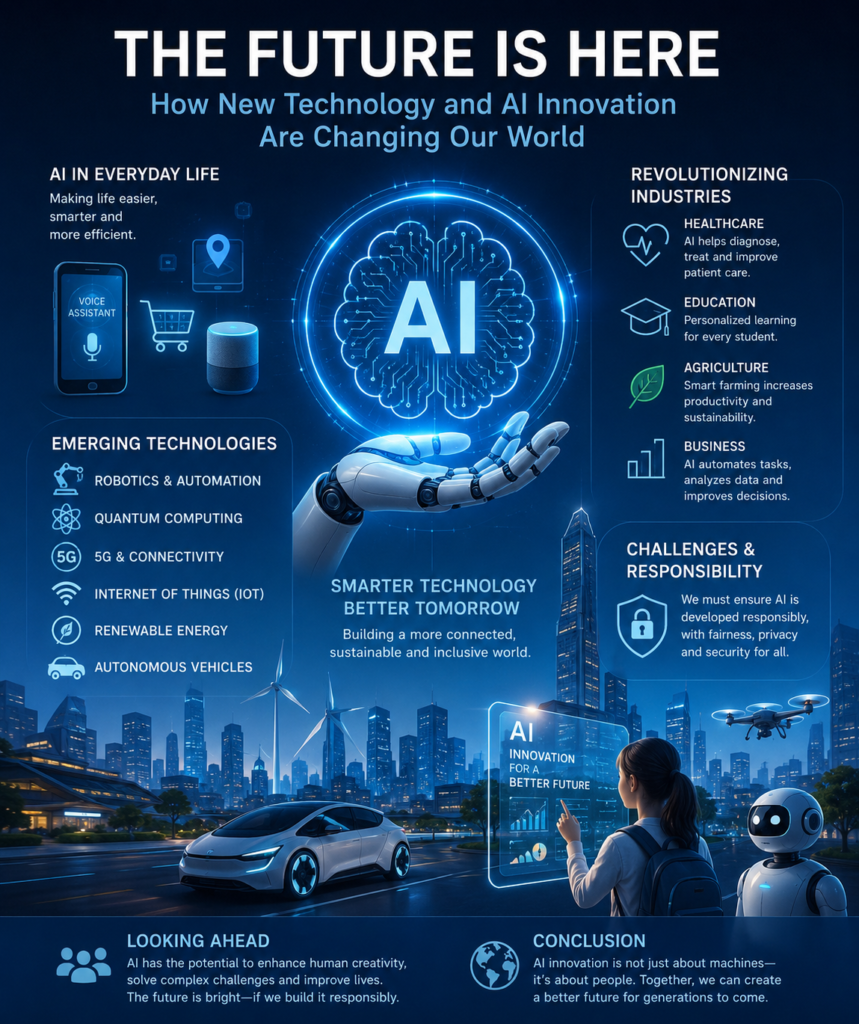
Technology is evolving faster than ever, and Artificial Intelligence (AI) is leading this transformation. From healthcare and education to agriculture and business, AI is helping people solve problems, save time, and create new opportunities.
AI in Everyday Life
Many people already use AI without realizing it. Voice assistants, navigation apps, online shopping recommendations, language translation, and smart cameras all rely on AI to make life easier and more efficient.
Revolutionizing Industries
AI is transforming many sectors:
Healthcare: AI helps doctors detect diseases earlier and improve patient care.
Education: Personalized learning platforms adapt lessons to each student’s needs.
Agriculture: Smart farming tools monitor crops, predict weather, and increase productivity.
Business: AI automates repetitive tasks, analyzes data, and improves customer service.
Emerging Technologies
AI is working alongside other groundbreaking technologies, including:
Robotics and automation
Quantum computing
5G and next-generation connectivity
Internet of Things (IoT)
Renewable energy innovations
Autonomous vehicles
Together, these technologies are shaping smarter cities, cleaner energy systems, and more connected communities.
Challenges and Responsibility
As AI becomes more powerful, it also raises important questions about privacy, cybersecurity, fairness, and the future of work. Governments, companies, and researchers must work together to ensure AI is developed responsibly and benefits everyone.
Looking Ahead
The future of AI is filled with possibilities. Instead of replacing human creativity, AI has the potential to enhance it by helping people innovate, learn faster, and solve complex global challenges. Those who embrace technology and continue learning new skills will be well positioned to thrive in the digital age.
Conclusion
AI innovation is not just about creating smarter machines—it is about improving lives. By using technology responsibly and ethically, we can build a future that is more efficient, inclusive, and sustainable for generations to come.
Leave a Reply